
The post TRON Network Can’t Compare: Bitcoin Everlight App Users Earning Life-Altering Bitcoin Rewards Overnight appeared first on Coinpedia Fintech News
TRON has long attracted participants focused on throughput efficiency, stablecoin transfers, and infrastructure-driven participation during uncertain market cycles. With broader crypto valuations compressed and many altcoins trading far below prior highs, users active on utility-heavy networks are reassessing how participation rewards behave when price recovery timelines remain unclear.
In this environment, a growing segment of TRON-aligned users is examining Bitcoin Everlight, a Bitcoin-adjacent transaction network that shifts participation rewards away from native-token dynamics and into Bitcoin earned from live network activity, managed directly through a mobile application.
TRON’s Network Model in Down Markets
The TRON network is widely used for high-volume stablecoin transfers and low-fee transactions. Its design emphasizes throughput and cost efficiency, making it a preferred settlement rail for USDT activity even when market sentiment weakens. Validator participation and protocol incentives typically distribute rewards in TRX or protocol-native assets, tying outcomes to the network’s internal economics.
During extended drawdowns, this structure keeps transaction volume resilient but leaves participants exposed to native asset price stagnation. For users accustomed to operating infrastructure or participating for network-level compensation, the limitation is not operational access but the denomination and source of rewards.
Bitcoin Everlight’s Participation Structure
Bitcoin Everlight operates as a lightweight transaction layer that runs alongside Bitcoin without modifying Bitcoin’s protocol or consensus. The network focuses on transaction routing, quorum-based confirmations measured in seconds, and predictable micro-fees, with optional anchoring back to Bitcoin for settlement reference.
This structure has positioned Everlight as a defensive participation model. Node operators earn Bitcoin generated from real transaction routing activity, separating participation outcomes from short-term altcoin price movements. When markets recover, network growth compounds participation value. When conditions remain compressed, operators continue earning BTC tied to usage and performance.
How Everlight Nodes Generate Bitcoin-Based Rewards
Everlight is operated by participants running specialized routing nodes, not full Bitcoin nodes. Operators commit BTCL to participate in transaction routing, maintain uptime, and support network performance. Compensation is paid in Bitcoin and calculated using routing volume, uptime coefficients, and performance metrics.
Nodes are organized into Light, Core, and Prime tiers. Higher tiers carry increased routing responsibility, priority access, and a larger share of BTC-denominated rewards. There is no mandatory lock period, allowing operators to enter or exit freely while rewards reflect active participation. Current network estimates indicate Bitcoin-denominated annualized returns reaching up to 21%, derived from live transaction usage and operator performance.
Nodes that underperform see reduced routing priority and lower compensation, while consistently reliable nodes receive greater routing flow. This ties rewards to measurable contribution instead of passive exposure.
Everlight App Brings Operations to Mobile
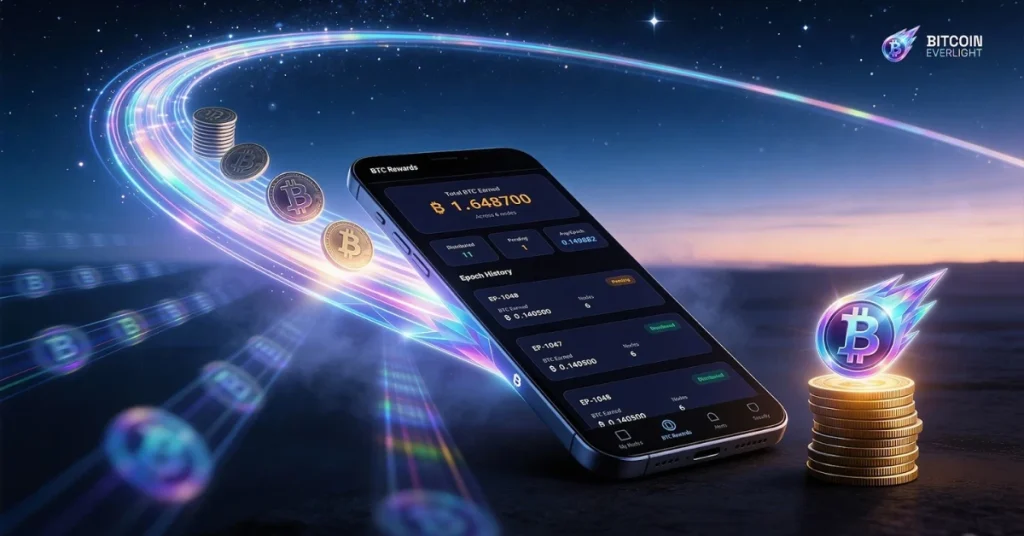
Everlight extends node participation through a dedicated mobile application designed for real-time network oversight. The app allows operators to monitor node status, uptime, and routing activity directly from a smartphone, eliminating the need for constant desktop access.
BTC earned from network usage is tracked within the app, alongside performance metrics and participation tier status. Smart alerts notify operators of uptime disruptions, routing changes, and BTC distribution events. This mobile-first design lowers operational friction for participants accustomed to app-based asset and infrastructure management.
Multiple independent analysts reviewed Bitcoin Everlight’s node structure, Bitcoin-denominated reward model, and mobile-based participation. A recent breakdown by Crypto League walks through how operators manage nodes, track BTC earnings, and interact with the network through the Everlight app.
TRON Network vs. Bitcoin Everlight
The shift attracting TRON users centers on how participation rewards are generated and denominated. The comparison below highlights structural differences without relying on market assumptions.
| Feature | TRON Network | Bitcoin Everlight |
| Primary Network Focus | High-throughput transactions, stablecoin transfers | Bitcoin transaction routing and lightweight confirmation |
| Reward Denomination | TRX or protocol-native assets | Bitcoin (BTC) from network activity |
| Participation Structure | Validator-based, limited set | Open node participation with tiered roles |
| Confirmation Speed | Seconds | Seconds via quorum confirmation |
| Fee Model | Low-cost, resource-based | Predictable micro-fees |
| Mobile Infrastructure Control | Limited native options | Native Everlight app |
| Bitcoin Integration | None | Optional anchoring to Bitcoin |
| Mandatory Lock Period | Protocol-dependent | None required |
Security Reviews, Team Identity, and Presale Structure
BTCL operates with a fixed total supply of 21,000,000,000 tokens, distributed across a predefined allocation structure. Of the total supply, 45% is allocated to the public presale, 20% to node rewards and network incentives, 15% to liquidity provisioning, 10% to the team under vesting conditions, and 10% reserved for ecosystem development and treasury use.
The presale follows a 20-stage structure and is currently in Phase 3, priced at $0.0012. Presale allocations release 20% at token generation, with the remaining 80% distributed linearly over a six- to nine-month period. Team allocations are subject to a 12-month cliff followed by 24 months of linear vesting. BTCL’s utility is limited to transaction routing fees, node participation thresholds, performance-based incentives, and anchoring operations tied to network activity.
For participants assessing operational and custody-related risk, Bitcoin Everlight has completed multiple independent security reviews covering its smart contracts and network components, including a SpyWolf Audit and a SolidProof Audit. Team identity has also been verified through SpyWolf Team and Vital Block team validation, providing additional transparency around project accountability.
See how the Bitcoin Everlight app enables BTC-based network participation during volatile markets.
- Website: https://bitcoineverlight.com/
- Security: https://bitcoineverlight.com/security
- How to Buy: https://bitcoineverlight.com/articles/how-to-buy-bitcoin-everlight-btcl
